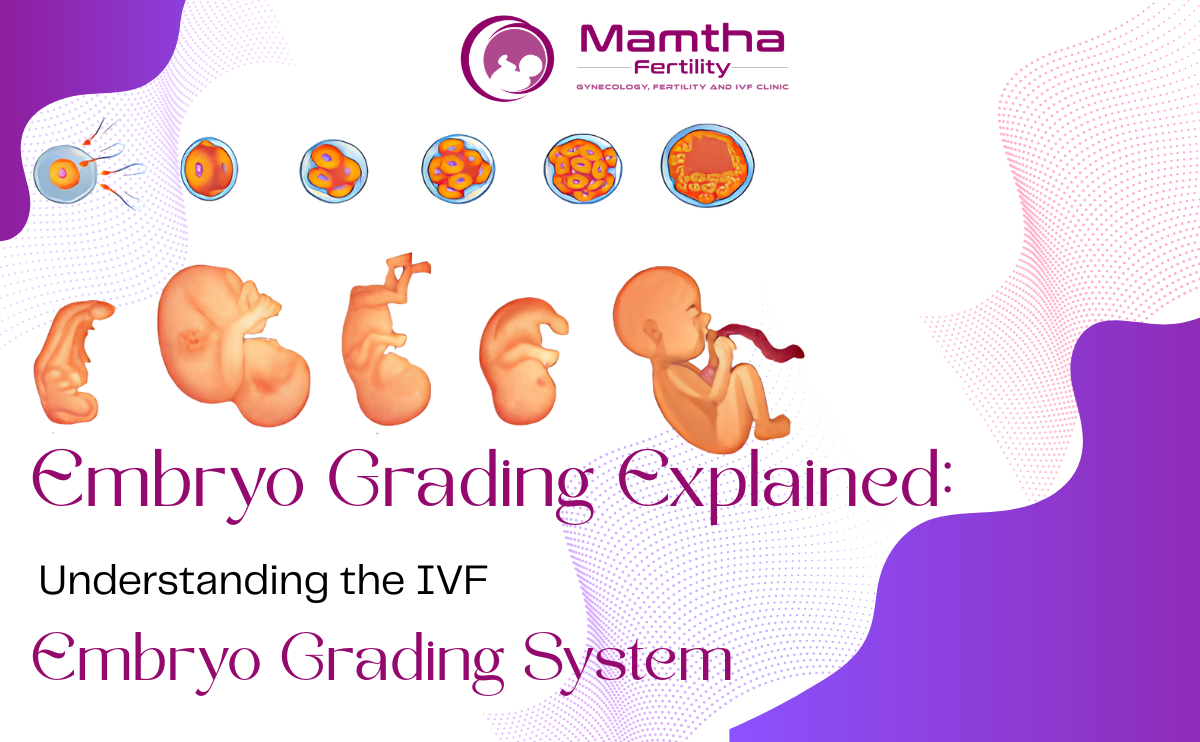

Embryo Grading Explained: Understanding the IVF Embryo Grading System
Table of Contents
ToggleKey Takeaways
- Embryo grading helps doctors check embryo quality during IVF.
- Grading happens on Day 3 and Day 5.
- The blastocyst grading system uses a number and two letters.
- A high grade shows good structure but does not guarantee pregnancy.
Introduction
When couples go through IVF, they often see terms like 4AA, 5AA, or 4BB in their report. These codes can be confusing. Therefore, this guide provides embryo grading explained in simple and clear language.
Embryo grading is a way to describe how an embryo looks under a microscope before transfer. It helps doctors choose which embryo to transfer first. However, grading does not promise pregnancy. It only shows how well the embryo has developed at that stage.
To understand grading better, it helps to know how embryos grow in the lab.
How Embryos Develop From Day 1 to Day 5
Embryo growth follows a clear pattern inside the IVF lab.
Day 1 – Fertilisation
On Day 1, the egg and sperm join to form a zygote. The lab team confirms normal fertilisation before the embryo continues to grow.
Day 2 – Early Division
By Day 2, the embryo usually divides into 2 to 4 cells. The cells should divide evenly.
Day 3 – Cleavage Stage
By Day 3, the embryo often has 6 to 8 cells. This is the first stage when doctors may assess quality.
They look at:
- Number of cells
- Cell symmetry
- Fragmentation
High fragmentation may reduce potential. However, some Day 3 embryos still improve by Day 5.
Day 4 – Morula Stage
On Day 4, the cells compact tightly together. This prepares the embryo for blastocyst formation.
Day 5 – Blastocyst Stage
By Day 5, the embryo becomes a blastocyst. It now has two main parts:
- Inner cell mass (future baby)
- Trophectoderm (future placenta)
Most grading decisions happen at this stage.
Day 3 Embryo Grading Explained
Day 3 grading focuses on cell division.
An ideal Day 3 embryo:
- Has 6 to 8 cells
- Shows low fragmentation
- Has even cell size
Although useful, Day 3 grading gives limited information. That is why many clinics prefer Day 5 grading.
Day 5 Blastocyst Grading System Explained
The blastocyst grading system uses one number and two letters.
Example: 4AA.
What the Number Means
The number shows expansion stage:
1 – Early blastocyst
2 – Developing blastocyst
3 – Full blastocyst
4 – Expanded blastocyst
5 – Hatching blastocyst
6 – Fully hatched blastocyst
Higher expansion means the embryo is more developed. However, it does not guarantee success.
What the First Letter Means
The first letter grades the inner cell mass.
A – Strong and tightly packed
B – Moderate grouping
C – Few or uneven cells
What the Second Letter Means
The second letter grades the trophectoderm.
A – Many healthy cells
B – Moderate layer
C – Thin or uneven layer
So, 4AA means expanded blastocyst with strong inner and outer cell layers.
What Makes an Embryo High Grade?
High-grade embryos:
- Reach blastocyst stage
- Show clear structure
- Have strong inner cell mass
- Have cohesive outer cells
However, embryo grading explained clearly means understanding that visual quality is only one part. Implantation also depends on hormones, uterine lining, and overall fertility
How Doctors Choose an Embryo
Doctors do not rely on grades alone. They also consider:
- Age
- Medical history
- Uterine health
- Previous IVF cycles
Sometimes fertilisation is done using ICSI. Even then, grading follows the same system.
Each decision is personalised.
Why Pregnancy May Not Happen With a Good Embryo
Even strong-looking embryos may not implant. This can happen because of:
- Chromosomal problems
- Hormonal imbalance
- Poor uterine receptivity
- Age-related egg decline
When implantation fails, doctors review previous failure before planning the next step.
Conclusion
This guide has provided embryo grading explained in a simple and structured way. Grading helps doctors evaluate embryo development during IVF. However, it does not guarantee pregnancy.
Because many factors affect success, discussing your report with your treating doctor is important for personalised advice.
Frequently Asked Questions
Which is better, 4AA or 5AA?
Both are high-quality embryos. The difference is only in expansion stage.
What is the difference between embryo grading and PGT?
Grading checks structure. PGT checks chromosomes. They measure different things.
How do doctors choose which embryo to transfer?
Doctors consider grade, age, and uterine health before choosing
Why does IVF fail with good embryos?
Implantation depends on genetics and uterine factors, not only grade.
Can a 5 day blastocyst become twins?
Yes, but it is rare. A single embryo can sometimes split naturally.